
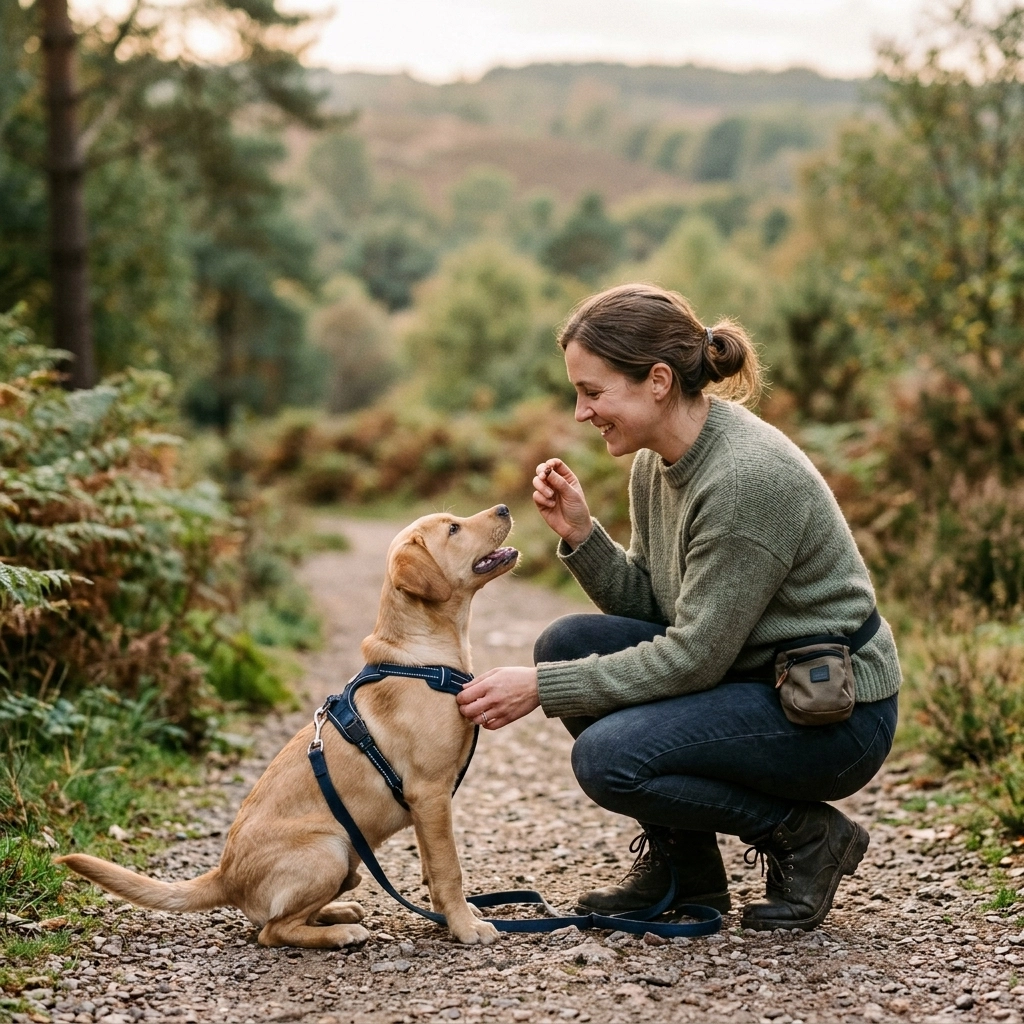
If your dog pulls on the lead, struggles around other dogs, barks at visitors or ignores you outdoors, you’re not alone. These challenges can make everyday life stressful, particularly when general advice doesn’t seem to fit your dog.
1-1 dog training in Cannock provides focused, practical support for your dog and your household. Rather than following a standard class plan, our sessions are shaped around your dog’s behaviour, your goals and the places where you need the most help.
Personalised coaching doesn’t promise an instant fix. However, it can often help you make progress faster because each session deals directly with the behaviours that affect your daily life.
Why Choose 1-1 Dog Training in Cannock?
Group classes can be valuable for socialisation, basic skills and learning around controlled distractions. Nevertheless, they can’t always give enough time to individual problems, especially when several dogs need attention at once.
With professional 1-1 dog training in Cannock, the trainer can focus fully on you and your dog. This means we can observe small details in your dog’s body language, identify likely triggers and adjust the plan as the session develops.
Private coaching can be particularly helpful if your dog:
- Pulls strongly or becomes difficult to manage on walks.
- Barks, lunges or reacts when seeing dogs, people, cyclists or vehicles.
- Struggles to settle at home or greets visitors in an over-excited way.
- Has unreliable recall around wildlife and outdoor distractions.
- Is a nervous rescue dog or finds group classes overwhelming.
- Needs support with puppy manners, nipping, jumping or focus.
- Behaves differently at home compared with a training hall.
Furthermore, mobile training allows us to work in realistic settings. A dog that listens perfectly in a quiet class may still struggle on a busy pavement, near Hednesford Hills or along a woodland trail.

How Personalised Dog Training in Cannock Can Work Faster
The main advantage of individual training is not that your dog learns at an unrealistic speed. Instead, it’s that less time is spent practising exercises that don’t relate to your situation.
1. The training starts with your dog’s real behaviour
At the beginning, we’ll discuss your dog’s history, routine, health, motivation and current challenges. We’ll also look at what happens before and after a behaviour, rather than focusing only on the behaviour itself.
For example, lead pulling may be linked to excitement, frustration, fear or simply a lack of learned alternatives. The right plan depends on the reason behind it. A personalised assessment helps us avoid guessing.
2. The difficulty can be adjusted immediately
Every dog learns at a different pace. If an exercise is too easy, we can add a little more distance or distraction. If your dog is struggling, we can make the task simpler so they can succeed without becoming overwhelmed.
This flexibility is important for dogs that are anxious, highly excitable or easily distracted. It also helps puppies and older dogs, whose physical and emotional needs may be very different.
3. You receive coaching, not just instructions
The aim of 1-1 dog training in Cannock isn’t for a trainer to take over while you watch. You need to understand how to continue the work between sessions.
We’ll demonstrate an exercise, explain why it matters and then coach you while you practise. You’ll learn how to recognise early signs of stress or excitement, reward useful choices and respond calmly when things don’t go to plan.
That owner coaching is essential. Your dog spends most of their time with you, so clear and consistent handling at home is what turns a training exercise into a reliable everyday habit.
A Balanced Approach to Dog Training in Cannock
Dog training is sometimes described as either “positive-only” or “traditional”. In practice, good training needs to be clear, fair and appropriate for the individual dog.
Our balanced approach focuses on rewarding behaviours you want to see, while also setting sensible boundaries and managing situations your dog isn’t ready to handle. Rewards may include food, toys, praise, play or access to something your dog enjoys.
Boundaries don’t need to involve fear or pain. They can include calmly interrupting an unwanted behaviour, removing access to a reward, increasing distance from a trigger, changing the environment and teaching an alternative response.
For example, if your dog jumps at visitors, you might:
- Prevent the dog from rehearsing the behaviour by using a lead or stair gate.
- Ask visitors to wait until your dog has settled.
- Reward four paws on the floor.
- Offer a calm alternative, such as going to a bed.
- Repeat the routine consistently.
This gives your dog clear information without relying on shouting, intimidation or equipment designed to cause discomfort. Welfare organisations such as the RSPCA and Dogs Trust also provide guidance on humane, reward-based training.
Practical Tips Before Your 1-1 Dog Training Session in Cannock
You can help your dog get more from their first session with a little preparation.
Keep a short behaviour diary
For several days, make a note of:
- What behaviour you’re concerned about.
- Where it happens.
- The people, dogs, sounds or objects involved.
- What your dog does immediately beforehand.
- What helps your dog calm down.
- Which rewards your dog values most.
This information helps us understand patterns that may not be obvious during a single appointment.
Bring suitable equipment
A well-fitted harness or flat collar, a standard lead and small treats are usually useful. Avoid making sudden equipment changes immediately before a session, as unfamiliar items may add unnecessary stress.
It’s also helpful to bring a favourite toy if your dog prefers play to food. The most effective reward is the one your dog genuinely wants.
Keep practice short
Most dogs learn more effectively through short, regular practice than through one long session. Five to fifteen minutes at a time can be enough, depending on your dog’s age, energy and concentration.
If your dog becomes frustrated or tired, finish with an easy exercise they know well. Therefore, training remains a positive and manageable part of the day.

Local Dog Training in Cannock: From Home to Cannock Chase
One benefit of mobile dog training in Cannock is the opportunity to work in the places you actually use. We may begin at home if your dog struggles with visitors, settling, doorways or household routines.
Outdoor sessions can then build towards quieter paths, pavements and busier public areas. Cannock Chase offers a useful variety of woodland, open spaces and shared trails, although the environment needs to be treated responsibly.
Forestry England’s Cannock Chase information highlights the area’s walking routes and dog-friendly activities. The Dog Activity Trail at Pingle Slade includes activities such as fetching, weaving and jumping.
However, Cannock Chase is also shared with cyclists, horse riders and other walkers. Wildlife, including deer, can be a major distraction. Your dog should remain under control, and you should follow signs and local guidance about leads, wildlife and busy areas.
Other locations may include:
- Quieter residential routes in Cannock and Hednesford.
- Open areas around Shoal Hill Common.
- Mill Green and Hawks Green Valley for calmer walking practice.
- Busier town-centre environments when your dog is ready.
- Familiar routes where lead manners and recall need to improve.

The aim isn’t simply to teach a behaviour in one place. It’s to help your dog understand that the same communication applies across different environments.
1-1 Dog Training in Cannock for Puppies and Older Dogs
Personalised training is suitable for dogs at different stages of life. Puppies may need help with toilet routines, biting, jumping, focus and settling. Older dogs may need a refresher after a change in home, routine or health.
Private sessions can also be useful for rescue dogs that need time to build confidence. We’ll work within your dog’s limits and increase difficulty gradually rather than forcing them into situations they can’t yet manage.
If you’re deciding between private coaching and group classes, our guide to 1-1 dog training versus group classes explains how the two options can suit different needs. Our group training may also be appropriate once your dog is ready to learn around others.
What to Expect from Professional 1-1 Dog Training in Cannock
A typical training programme may include:
- Initial assessment: We discuss your concerns, goals and dog’s history.
- Observation: We look at how your dog responds to you, the environment and possible triggers.
- Demonstration: We show you the exercise and explain the purpose behind it.
- Owner coaching: You practise while receiving clear, immediate feedback.
- Real-life training: We gradually introduce suitable distractions and locations.
- Home practice: You receive straightforward exercises to work on between sessions.
- Review: We assess progress and adapt the plan when necessary.
Progress is rarely completely linear. Your dog may manage a behaviour one day and struggle the next because of tiredness, illness, weather, distractions or an unexpected trigger. A professional plan should allow for these setbacks rather than treating them as failure.
The Takeaway: Personalised Coaching Builds Practical Progress
Professional 1-1 dog training in Cannock can help you address specific challenges with a plan built around your dog and your lifestyle. Focused attention, real-world practice and owner coaching often make progress more efficient than trying to follow general advice alone.
Moreover, effective training is about more than obedience. It helps you communicate clearly, manage difficult situations safely and build a more trusting relationship with your dog.
Contact Us
If you’d like support with your dog’s behaviour, our team at The Pet Leisure Co is ready to help.
- Visit our website: petleisure.co.uk
- Book a dog training consultation: Dog Training Consultation
- Call us: 01543 523 850
- Email us: [email protected]
- Explore further guidance: The Ultimate Guide to 1-1 Dog Training in Cannock
We’ll help you create a clear, practical training plan for everyday life with your dog.
